Run Ansible Automation Directly from Nautobot
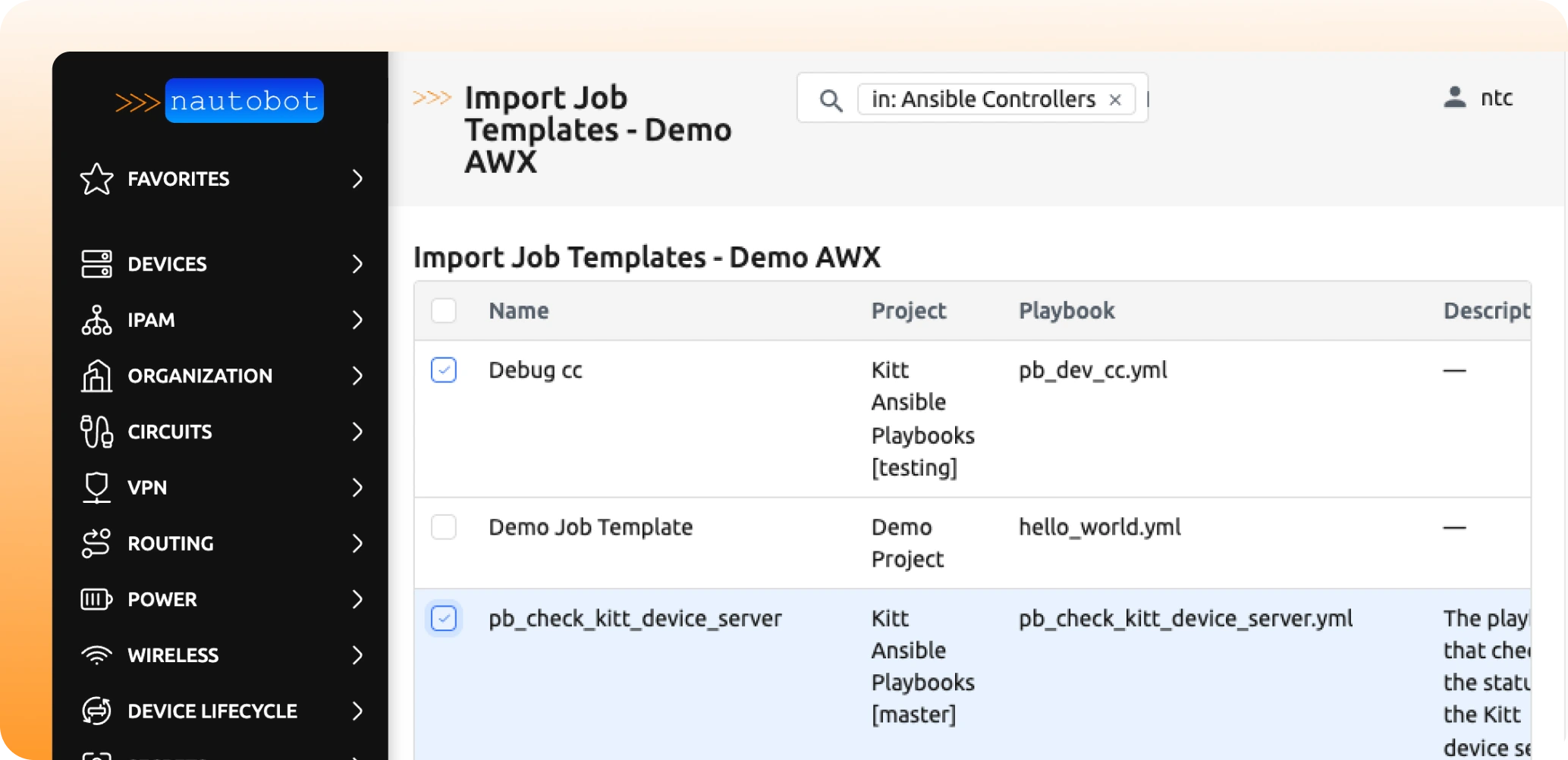
The Nautobot Ansible Automation Application integrates Nautobot with AWX and Red Hat Ansible Automation Platform (AAP), enabling teams to discover, manage, and run Ansible Job Templates directly from the Nautobot Jobs interface. Nautobot provides the operational front end while Ansible remains the execution engine, allowing teams to launch automation using authoritative network data without switching tools.
By combining Nautobot’s network data models with Ansible’s automation capabilities, teams gain a unified workflow for executing network automation while maintaining existing DevOps practices.
Ansible has become one of the most widely used platforms for network automation. Many teams rely on AWX or Red Hat Ansible Automation Platform to manage playbooks and job templates.
However, operational network data typically lives somewhere else, often in systems like Nautobot that act as the source of truth for network infrastructure.
As a result, engineers frequently move between multiple interfaces to run automation.
A typical workflow often looks like this:
This fragmented workflow introduces operational friction and increases the risk of mistakes.
Common challenges include:
NetOps teams want automation tightly aligned with authoritative network data. DevOps teams want to maintain their existing Ansible workflows.
Without integration between these systems, organizations struggle to scale automation consistently and securely.
Bottom line:
When network data and automation execution live in separate systems, running automation becomes slower, less consistent, and harder to manage.
With the Nautobot Ansible Automation Application deployed, automation workflows become simpler, more consistent, and easier to manage.
Engineers launch automation from the same platform that manages network infrastructure data.
Ansible continues to handle playbook execution while Nautobot provides operational context and visibility.
This creates a unified workflow for network automation across NetOps and DevOps teams.
Organizations gain a single operational interface for automation while preserving their existing Ansible automation ecosystem.
The Nautobot Ansible Automation Application bridges the gap between network data and automation execution.
It integrates Nautobot directly with AWX and Red Hat Ansible Automation Platform so teams can discover and run Ansible Job Templates directly from Nautobot’s Jobs interface.
In this architecture:
This approach preserves existing automation investments while providing a unified operational experience
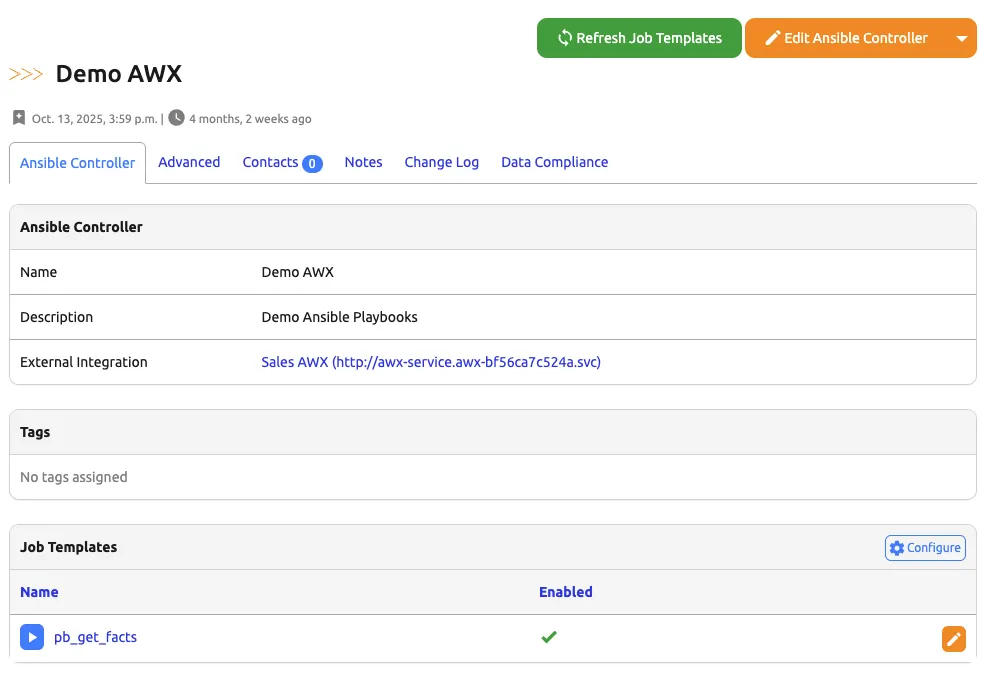
Nautobot connects to Ansible controllers using secure API integrations.
Through this integration, Nautobot can:
Administrators maintain control over which playbooks appear in Nautobot, ensuring that only approved automation workflows are available to operators.
Ansible Job Templates often use surveys to collect input variables.
The Nautobot Ansible Automation Application automatically converts these surveys into Nautobot Job Variables.
When an operator launches automation:
This reduces manual entry and ensures automation runs with accurate network data.
Once launched, Nautobot dispatches the job to the configured Ansible controller.
Automation execution still happens entirely within Ansible, but Nautobot provides the operational interface for triggering workflows.
This allows teams to:
The result is a streamlined experience where engineers can run automation without switching tools.
After execution, Nautobot imports job status and logs from the Ansible controller.
Operators can review:
Automation activity becomes visible within the same system that manages network data and operational workflows.
Bring Your Ansible Automation into Nautobot
Centralize network automation execution while continuing to use the Ansible ecosystem your teams already rely on.
Run playbooks using authoritative network data and manage automation workflows from a single operational interface.
No. Ansible remains the automation execution engine. Nautobot acts as the operational interface for discovering and launching automation workflows.
The application integrates with both AWX and Red Hat Ansible Automation Platform using their APIs.
Yes. Administrators selectively import approved Job Templates from the Ansible controller. Only imported templates are exposed in Nautobot.
Yes. Surveys are automatically converted into Nautobot Job Variables. Nautobot dynamically generates input forms when launching automation.
Credentials used for communication with the Ansible controller are securely stored in Nautobot using Secret Groups.
Yes. Nautobot imports job status, history, and output logs from Ansible so operators can review execution results without leaving Nautobot.
No. Playbooks remain unchanged and continue to run on the Ansible controller. The integration simply provides a new operational interface for launching them.
NetOps engineers use Nautobot to launch automation workflows, while DevOps teams continue maintaining automation logic and playbooks in Ansible.


Share details about yourself & someone from our team will reach out to you ASAP!