
Model BGP infrastructure directly in your network source of truth
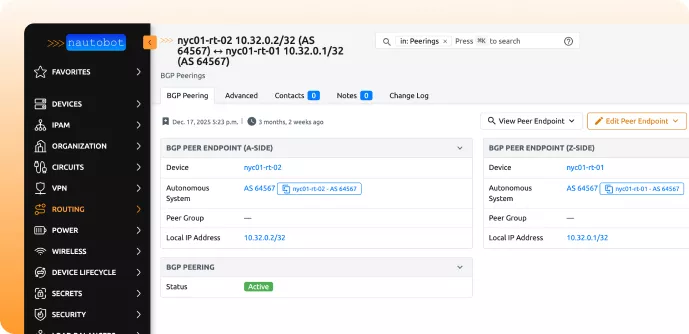
The Nautobot BGP Models App extends your Network Source of Truth with data models designed specifically for Border Gateway Protocol (BGP). It empowers teams to natively model autonomous systems, routing instances, peer groups, and BGP peerings directly within their network source of truth. By centralizing BGP relationships and configuration data in Nautobot, you can standardize routing information, automate configuration generation, and maintain consistent visibility across internal and external BGP relationships.
BGP is one of the most critical components of modern networks, but most infrastructure management platforms struggle to represent it accurately. Traditional network inventories focus on devices, interfaces, and topology, while BGP relationships span multiple devices, autonomous systems, and external peers.
As a result, many organizations manage BGP information outside their primary source of truth using spreadsheets, static documentation, or fragmented configuration files.
This creates several operational challenges:
Without a consistent data model for routing relationships, network automation initiatives struggle to generate reliable intended configurations or maintain accurate visibility into routing state.
Bottom line:
If BGP relationships are not modeled in the source of truth, automation pipelines lack the structured data required to reliably generate and validate routing configurations.
The BGP Models App introduces a set of purpose-built data models that allow organizations to represent BGP infrastructure in a structured and automation-friendly format. These models extend Nautobot’s core data model so BGP information becomes part of the same authoritative system used for topology, IPAM, and device inventory.
This allows network teams to treat BGP configuration as structured data rather than scattered configuration text.
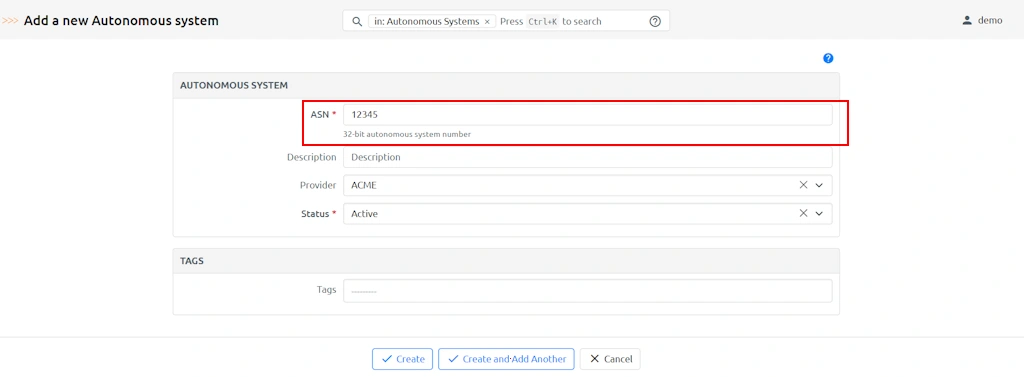
The app introduces an Autonomous System (AS) model that allows teams to represent network-wide ASNs and their associated metadata.
This provides a consistent way to track:
Representing ASNs centrally enables routing architecture to be managed consistently across devices and locations.
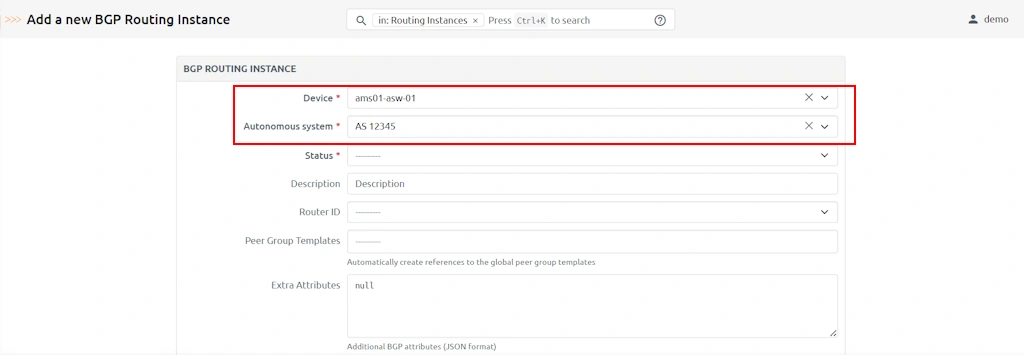
The BGP Routing Instance model represents a device-specific BGP process. This allows Nautobot to associate BGP configuration with specific devices while still maintaining a network-wide view of routing relationships.
Routing instances can include attributes such as:
This creates a clear link between device configuration and network-wide routing architecture.
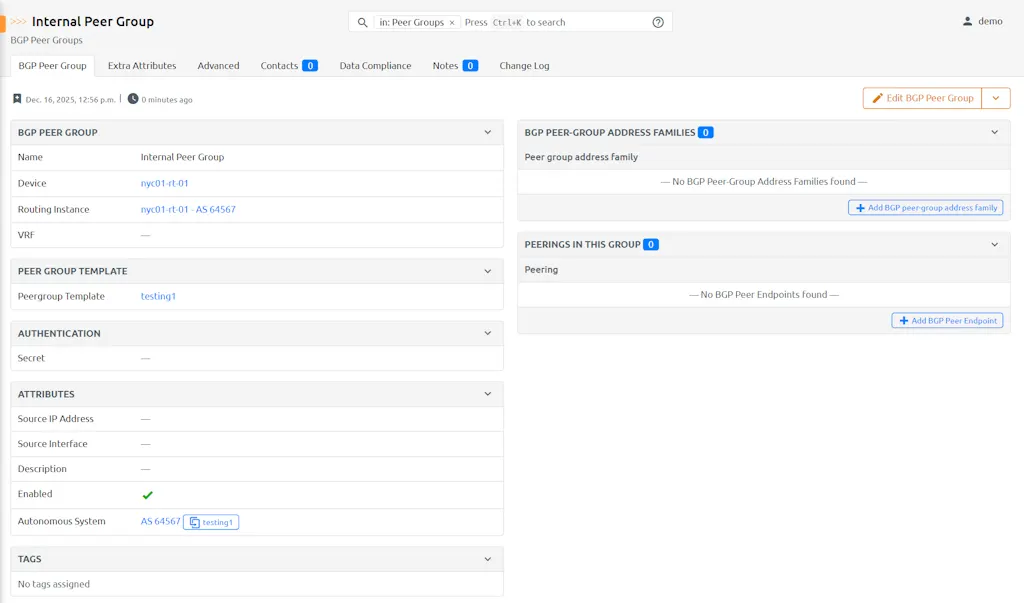
Large environments frequently rely on peer groups to simplify BGP configuration.
The BGP Models App supports this by introducing:
This structure allows teams to define standardized peering configurations and apply them consistently across devices.
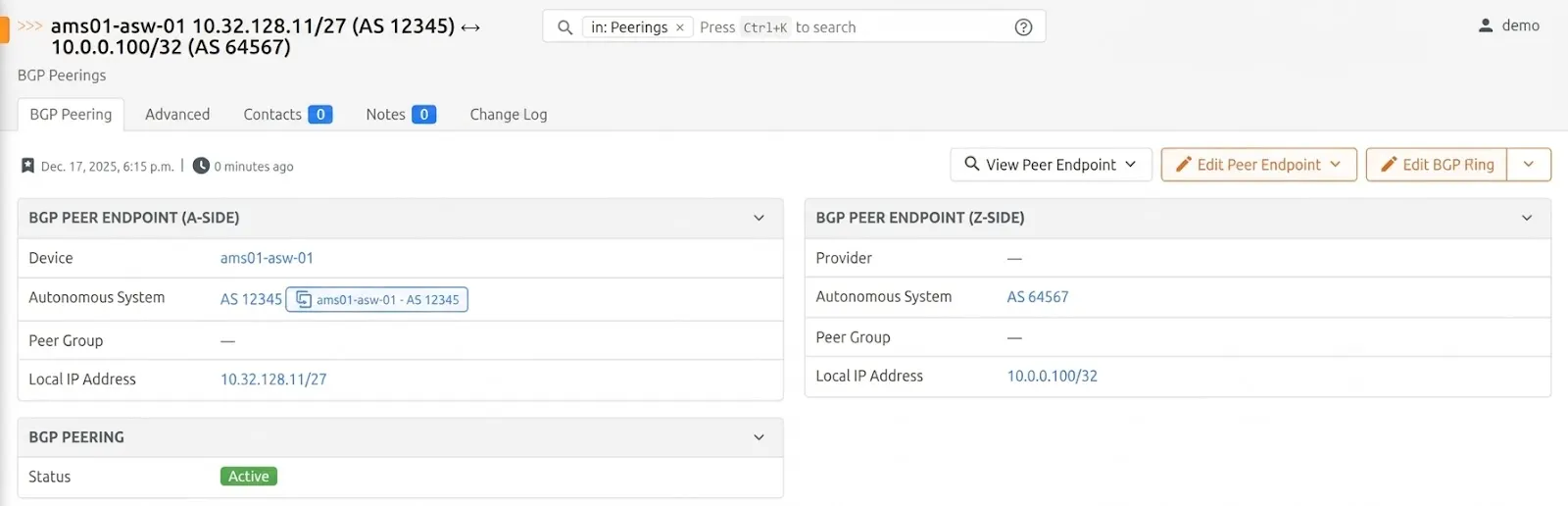
The app models a BGP relationship as a Peering object that contains two peer endpoints representing each side of the connection.
Each endpoint can define attributes such as:
This structure allows Nautobot to represent both internal peerings (iBGP) and external peerings (eBGP), even when the remote device is not modeled in Nautobot.
BGP data is transformed into structured, automation-ready data, stored in Nautobot. Your automation pipelines can reliably consume this authoritative source through:
For example, automation systems can query Nautobot for device routing data and generate intended BGP configurations automatically.
This transforms BGP configuration by eliminating reliance on manually maintained text into structured network data that your automation systems can query for device routing data and generate validated BGP configurations automatically.
When BGP data is modeled directly in Nautobot, network teams gain a unified view of routing relationships and a reliable foundation for automation.
Instead of piecing together BGP configuration from multiple sources, engineers can rely on a consistent data model that reflects the intended routing architecture of the network.
Operational improvements include:
This enables routing infrastructure to be managed using the same automation and source-of-truth principles applied to the rest of the network.
Bring BGP into your network source of truth
The BGP Models App allows organizations to model routing infrastructure directly in Nautobot, creating a reliable data foundation for BGP automation and configuration generation.
The app introduces additional data models that allow Nautobot to represent BGP routing concepts such as autonomous systems, routing instances, peer groups, and BGP peerings.
Yes. BGP peerings can be modeled even when the remote endpoint is not represented as a device in Nautobot. This allows organizations to track relationships with providers, partners, or internet exchanges.
Both internal BGP (iBGP) and external BGP (eBGP) peerings can be represented using the peering and peer endpoint models.
BGP data stored in Nautobot can be retrieved through APIs or GraphQL queries and used by automation tools to generate intended configuration, validate routing architecture, or drive configuration pipelines.
Yes. The app includes models for peer groups and peer group templates, allowing teams to define shared configuration that can be applied across multiple BGP peers.
Yes. Many BGP models support additional attributes stored as JSON fields, allowing organizations to store vendor-specific or environment-specific routing parameters.
No. Any organization using BGP, including enterprises, cloud providers, and SaaS platforms, can use the app to represent routing relationships within their network source of truth.
The data models support Nautobot’s core platform features including APIs, GraphQL queries, change logging, webhooks, custom fields, and relationships.


Share details about yourself & someone from our team will reach out to you ASAP!


