Build and deploy networks using design-driven automation
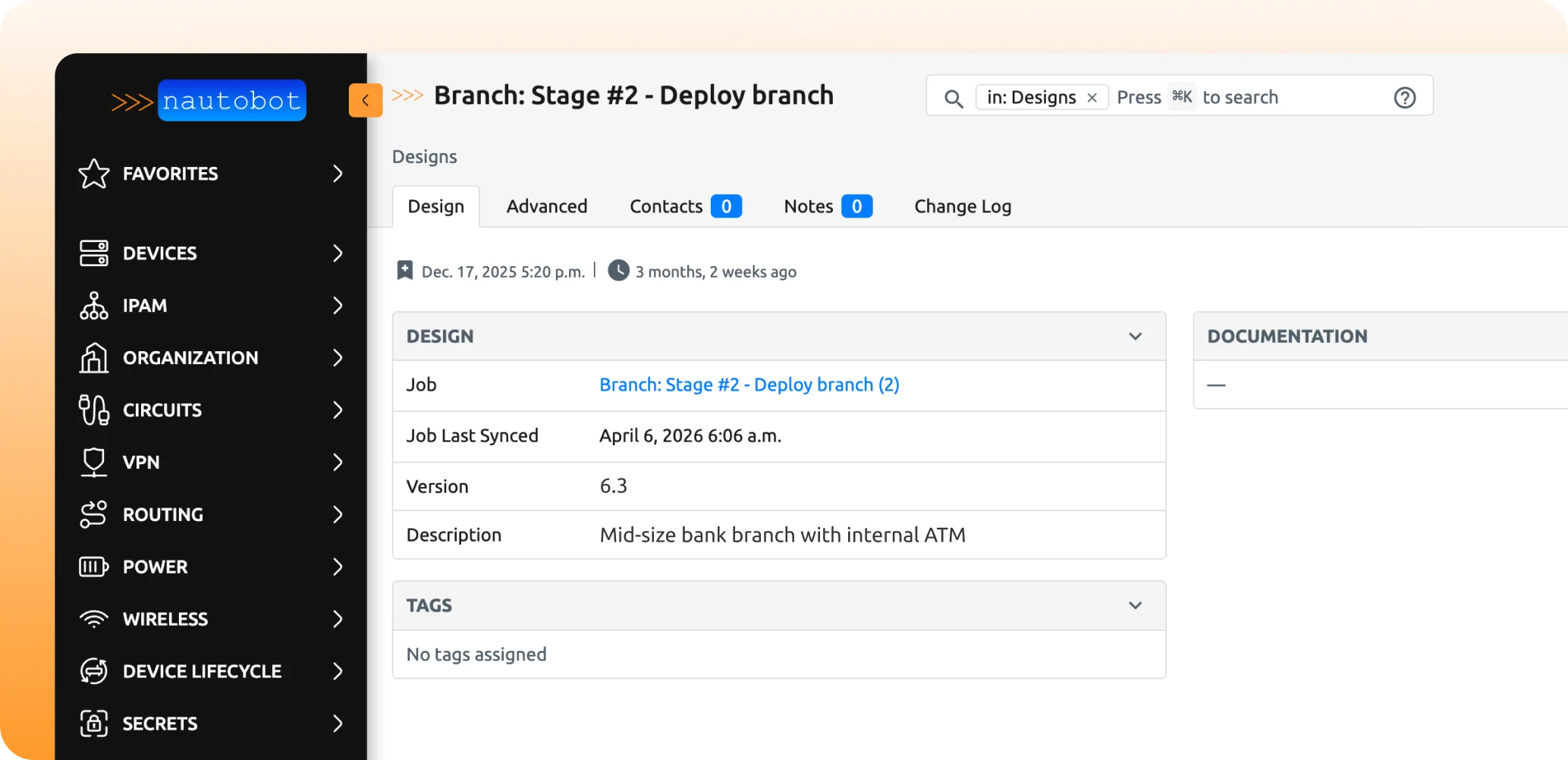
Modern networks evolve faster than traditional manual processes can support. Nautobot Design Builder enables teams to codify network designs as reusable templates that automatically generate infrastructure data, device configurations, and topology objects within Nautobot. By standardizing architecture patterns and automating their implementation, Design Builder helps organizations deploy new network environments faster, maintain consistency across sites, and reduce operational risk.
Instead of manually configuring devices or recreating topologies from scratch, engineers can define reusable designs and allow Nautobot to automatically build the intended network state.
Network teams today face growing operational complexity driven by several trends.
Multi-vendor infrastructure
Enterprise networks rarely rely on a single vendor. Platforms from Cisco, Juniper, Arista, Fortinet, Palo Alto, and cloud providers all introduce different APIs, configuration models, and lifecycle management requirements.
This diversity creates operational challenges:
Constant technology evolution
Networks now support far more than traditional routing and switching.
New technologies continuously expand the operational scope of infrastructure teams:
Each new technology introduces new integration points, security requirements, and operational workflows.
Exploding device counts
Organizations are also managing a rapidly increasing number of network-connected devices:
Each device introduces additional provisioning, security, and monitoring requirements.
Skills shortages in network engineering
At the same time, the available pool of experienced network engineers is not growing fast enough to keep pace with infrastructure expansion. Organizations must manage increasingly complex networks with limited engineering resources.
The result: manual processes that cannot scale
Many teams still deploy network infrastructure through manual design documents, spreadsheets, and CLI-based configuration processes. This approach leads to:
Bottom line
Network teams need a scalable way to standardize architecture patterns and automatically generate infrastructure from those designs. This is where the Nautobot Design Builder app comes in.
Once Design Builder is implemented, infrastructure teams transition from manual configuration to design-driven automation. Engineers define architecture standards once and reuse them across deployments. Instead of building networks device-by-device, teams deploy infrastructure by selecting approved designs.
Operational improvements include
Key benefits
Nautobot Design Builder enables design-driven network automation by transforming architecture standards into reusable, programmatic designs. Instead of manually configuring networks, engineers define standardized building blocks that automatically generate the required network objects, configurations, and relationships within Nautobot.
Standardized network designs
Design Builder codifies common infrastructure patterns as reusable designs.
These designs represent repeatable subsets of a network, such as:
Macro designs:
Micro designs:
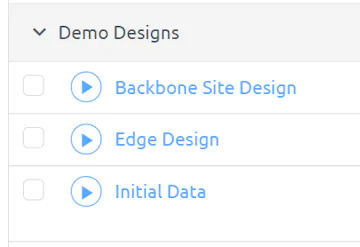
By defining these patterns once, teams can reuse them across thousands of deployments.
Design Builder separates architecture into two reusable layers.
Macro Designs
High-level infrastructure patterns that describe complete environments, such as:
Micro Designs
Smaller components that define standardized configurations and services, such as:
Micro designs can be combined to automatically construct macro architectures.
This modular approach allows teams to standardize network intent while remaining flexible.
Design Builder translates these designs into functioning Nautobot objects.
With just a few inputs from your team, Design Builder automatically generates the complete intended network state, including:
Design Builder automatically generates:
This process converts architecture standards directly into deployable infrastructure data.
Design Builder also simplifies large-scale network changes.
When a design is updated, such as modifying a standard port configuration or security policy, the change can be automatically propagated across all deployments using that design.
For example:
Updating a user port security template from:
port-security maximum 3
to
port-security maximum 4
can automatically regenerate thousands of interface configurations.
Instead of manually updating devices, engineers update the design itself.
Design Builder also enables controlled self-service infrastructure workflows.
Non-network teams can request network resources through simple forms, such as:
If the request matches an approved design template, Design Builder automatically generates the required configuration and network objects.
This enables faster service delivery while maintaining architectural standards.
Design Builder fits naturally into modern NetDevOps workflows.
After generating the intended network state in Nautobot:
This allows organizations to move toward fully automated network provisioning pipelines.
Automate your network architecture with Nautobot Design Builder
Standardize your network designs, accelerate deployments, and reduce operational risk with design-driven automation.
Design Builder is a Nautobot application that enables design-driven network automation. It allows teams to define reusable network architecture templates that automatically generate infrastructure objects and configurations within Nautobot.
Configuration templating focuses primarily on generating device configuration text. Design Builder operates at a higher level by generating complete infrastructure models, including devices, interfaces, IP allocations, relationships, and configurations.
Design-driven automation helps organizations standardize network architecture, reduce manual configuration work, and deploy infrastructure consistently across many sites.
No. Design Builder complements existing automation pipelines by generating the intended network state in Nautobot, which other tools can then deploy or validate.
Network architects typically define reusable design templates, while network engineers and automation teams use those designs to deploy infrastructure.
Yes. Because designs are reusable templates, they can generate infrastructure data for small deployments or large multi-site environments.
Yes. Design Builder operates within Nautobot’s data model, which supports multi-vendor network environments.
Yes. Design Builder integrates well with CI/CD pipelines, configuration automation frameworks, and other orchestration tools used in modern NetDevOps environments.


Share details about yourself & someone from our team will reach out to you ASAP!