Turn network data into reports built for any audience
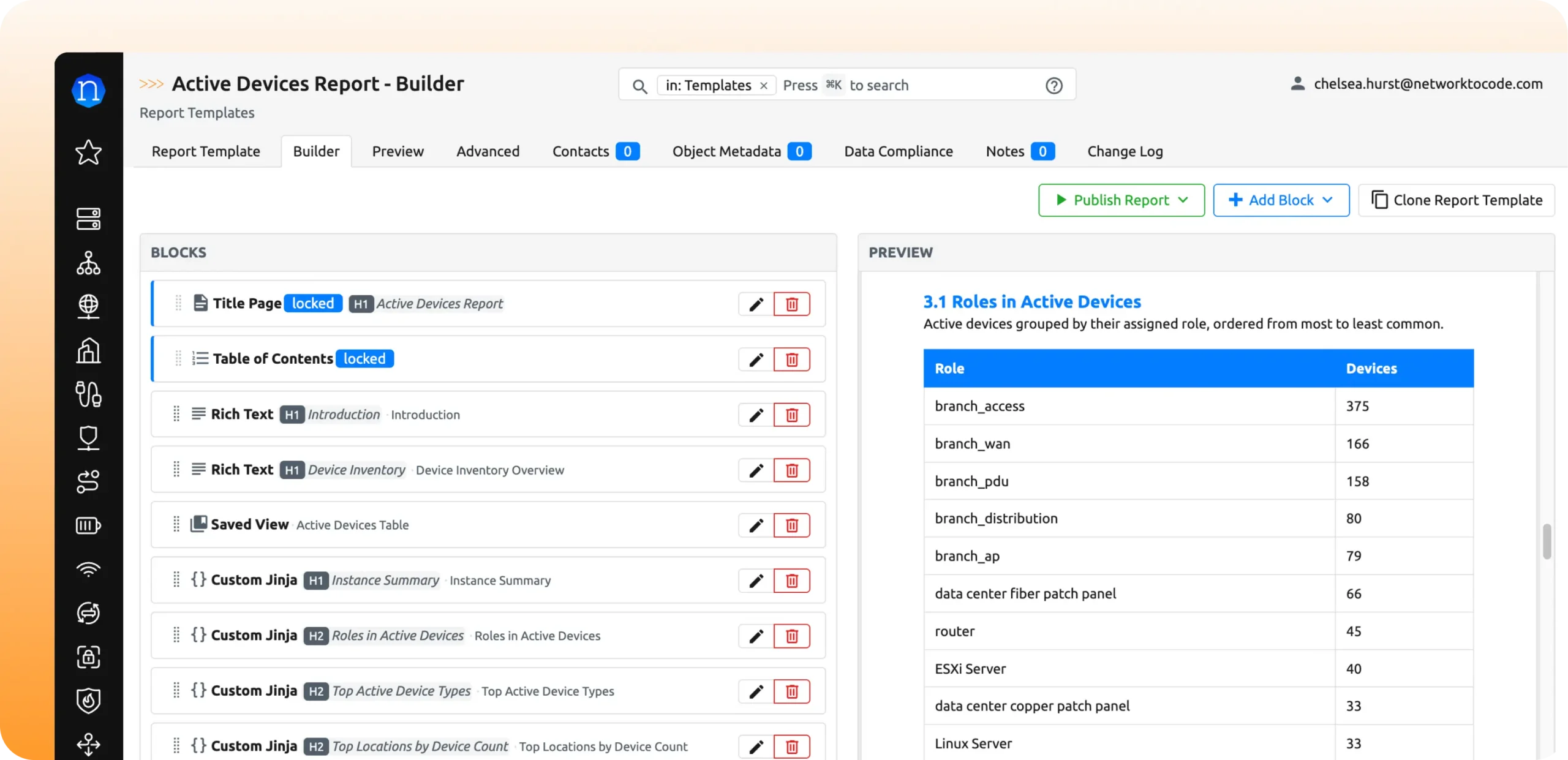
Nautobot Reports transforms live Nautobot data into professional, shareable reports for operations teams, auditors, customers, and business leaders. Build reusable report templates from Nautobot data, publish point-in-time snapshots, export results as PDF, DOCX, or HTML, and automatically deliver recurring reports by email, all from within your network automation platform.
Your network operations team may have detailed inventory, IPAM, circuit, location, and operational data in Nautobot. But the people who need that information are not always the people working directly with the platform.
Operations leaders need recurring status reports. Auditors need point-in-time evidence. Customers need clearly formatted deliverables. Executives need concise summaries of network footprint, capacity, and growth.
Getting the right data to each audience often means manually filtering tables, exporting data, copying information into documents, reformatting content, and emailing the finished report. The process is repetitive, difficult to standardize, and dependent on individuals knowing how to find and interpret the underlying network data.
Traditional exports solve only part of the problem. A raw CSV may contain the right data, but it is rarely an effective executive report, customer deliverable, or audit artifact. At the same time, giving every stakeholder direct access to Nautobot introduces unnecessary complexity when they simply need a specific view of the network state.
Manual reporting also creates consistency and auditability challenges. Filters can change. Templates are copied and modified. Data continues to evolve after a report is generated. Teams may struggle to establish exactly what information was reported at a specific point in time.
Bottom line: Network teams have the data, but turning it into consistent, repeatable, audience-ready reports requires too much manual work to deliver audience-ready reporting at scale .
With Nautobot Reports, network teams can move reporting closer to the source of their operational data.
Instead of manually reconstructing reports from spreadsheets, screenshots, and copied data, teams can define reusable templates that retrieve data from Nautobot, publish a point-in-time result, and deliver it in the appropriate format.
Technical teams spend less time reproducing routine reports. Stakeholders receive information in a format designed for them. Compliance and audit teams gain durable historical artifacts. As network environments and reporting requirements grow, teams can scale reporting workflows through templates, jobs, and scheduling rather than adding more manual processes.
Benefits include:
Nautobot Reports provides a flexible reporting workflow for retrieving, organizing, publishing, and distributing network data.
Using a drag-and-drop report template builder, teams can assemble reusable reports from Saved Views, Export Templates, Jinja Template sections, rich text, title pages, tables of contents, and page breaks. Each report pulls data from Nautobot and formats it for the people who need to consume it.
Advanced users can use Jinja templating to retrieve and transform data for specialized reporting requirements, while other users can assemble reports from predefined data views and report blocks.
Once published, a report becomes an immutable point-in-time snapshot. The published result remains available even if the original report template is later edited or deleted, providing a durable record of what was generated.
Different stakeholders need different representations of the same network data.
Build reports with title pages, tables of contents, rich text, Saved View tables, Export Templates, and Jinja-generated sections. Organize report content into a structured document designed for its intended recipient rather than sending an unformatted data export.
Use the same Nautobot data to support recurring operational reports, executive summaries, compliance evidence, customer deliverables, and ad-hoc requests from other teams.
Nautobot Reports supports both casual and advanced users.
The drag-and-drop template builder provides a structured way to assemble report content from existing Nautobot data sources. Advanced NetDevOps practitioners can use Jinja templates to retrieve, transform, and present data for more specialized requirements.
This flexibility allows teams to standardize common reports without limiting the ability to build highly specific outputs when needed.
Network data changes continuously. Reports often need to represent what was known or reported at a specific moment.
Each time a report is published, Nautobot Reports stores a frozen point-in-time snapshot of the result. The published report remains intact even if the underlying report template is later modified or deleted.
Use published reports to retain historical operational records, support compliance and audit workflows, and establish a consistent record of previously reported network state.
Generate reports as HTML, DOCX, or PDF artifacts.
Instead of forcing every recipient to work from the same raw export, teams can provide a report in a format appropriate for management, customers, auditors, or technical teams.
Reports can be downloaded for manual distribution or delivered directly from Nautobot.
Publish and email reports in a single workflow.
HTML reports can be embedded directly in the email body, while HTML, DOCX, and PDF reports can be delivered as attachments. Teams can configure recipient, CC, and BCC addresses, including Jinja template syntax for dynamic delivery requirements.
Individual Saved View and Export Template blocks can also be attached as CSV, DOCX, or PDF files. Attachment settings are configured per block, allowing a report to include a summarized view while delivering the underlying data as a separate file.
Blocks can even be configured as attachment-only, making it possible to send supporting data without displaying it in the report body.
Use Nautobot’s job scheduling capabilities to publish and email reports automatically at a future time or on a recurring schedule.
Generate a weekly active device report for operations. Send circuits-by-site data every Monday morning. Create recurring network inventory snapshots. Deliver scheduled customer reports without requiring an engineer to manually rebuild and send the same document.
Reporting becomes part of the network automation workflow instead of another manual operational task.
Nautobot Reports can support a range of reporting workflows, including:
Turn your network data into information people can use
Build reusable reports, automate recurring delivery, and share network data in the format each audience needs.
Nautobot Reports is a Nautobot App for creating professional, reusable reports from Nautobot data. Teams can build report templates, publish immutable point-in-time snapshots, export reports as HTML, DOCX, or PDF, and email reports manually or through scheduled jobs.
Report templates can include Saved View tables, Export Templates, Jinja Template sections, rich text, title pages, tables of contents, and page breaks. These blocks can be assembled into a structured report using the report template builder.
Not for every reporting workflow. Users can assemble reports from predefined report blocks and Nautobot data views. Advanced users can use Jinja templates when they need more control over data retrieval, transformation, or presentation.
Yes. Report publishing and email delivery are job-based and can use Nautobot’s job scheduling capabilities. Reports can be scheduled to run and email at a future time or on a recurring schedule.
Published reports can be generated as HTML, DOCX, or PDF. HTML content can also be embedded directly in an email body, and complete reports can be sent as attachments.
Yes. Saved View and Export Template blocks can be configured to attach their data as CSV, DOCX, or PDF files when a report is emailed. Attachment row limits can be configured independently of the number of rows displayed inline in the report.
No. A published report is an immutable point-in-time snapshot. Once published, the report preserves the generated result even as Nautobot data changes or the original report template is edited or deleted.
Yes. Reports can be downloaded or emailed as HTML, DOCX, or PDF artifacts. This allows operations leaders, auditors, customers, and other stakeholders to consume network information without needing to access or query Nautobot directly.
Common workflows include recurring network inventory and status reports, compliance and audit evidence, executive network summaries, customer or tenant deliverables, and ad-hoc data exports for other teams.
Some capabilities require additional configuration or dependencies. Email delivery uses Django’s email framework and requires the appropriate email backend and SMTP settings. PDF generation requires WeasyPrint and its system dependencies. DOCX generation uses additional document-generation dependencies. Required packages must be available to the Nautobot workers that publish reports.


Share details about yourself & someone from our team will reach out to you ASAP!